 Panacea Bio ChemArgonLock · Data Report
Panacea Bio ChemArgonLock · Data Report
Panacea Bio ChemArgonLock · Data Report
Controlled argon conditioning — not a heavy gas sitting on top. In dry cakes argon backfills the cake in full at the end of lyophilisation, then the Vana Machine replaces only a controlled fraction of a fresh vacuum with argon as it locks the closure; in the P-EARLs and Liquiprester liquids argon is dissolved in. A low-oxygen environment defined by composition and closure integrity.
In a conventionally filled vial: usually nitrogen, sometimes argon, sometimes nothing but a partial vacuum, occasionally plain air. Something has to be, because whatever occupies the container at the instant it is closed is sealed in with the dried cake for the whole of its shelf life. Ordinary air is roughly 21% oxygen, and a lyophilized cake is a high-surface-area sponge; a gas that cannot oxidise anything is therefore worth more than a gas that can. The FDA’s own inspection guide for lyophilized parenterals describes the industry default plainly — a nitrogen flush, and a nitrogen system used to backfill6. That the gas matters at all is not folklore: moisture and oxygen were shown to change the storage stability of a freeze-dried protein three decades ago7.
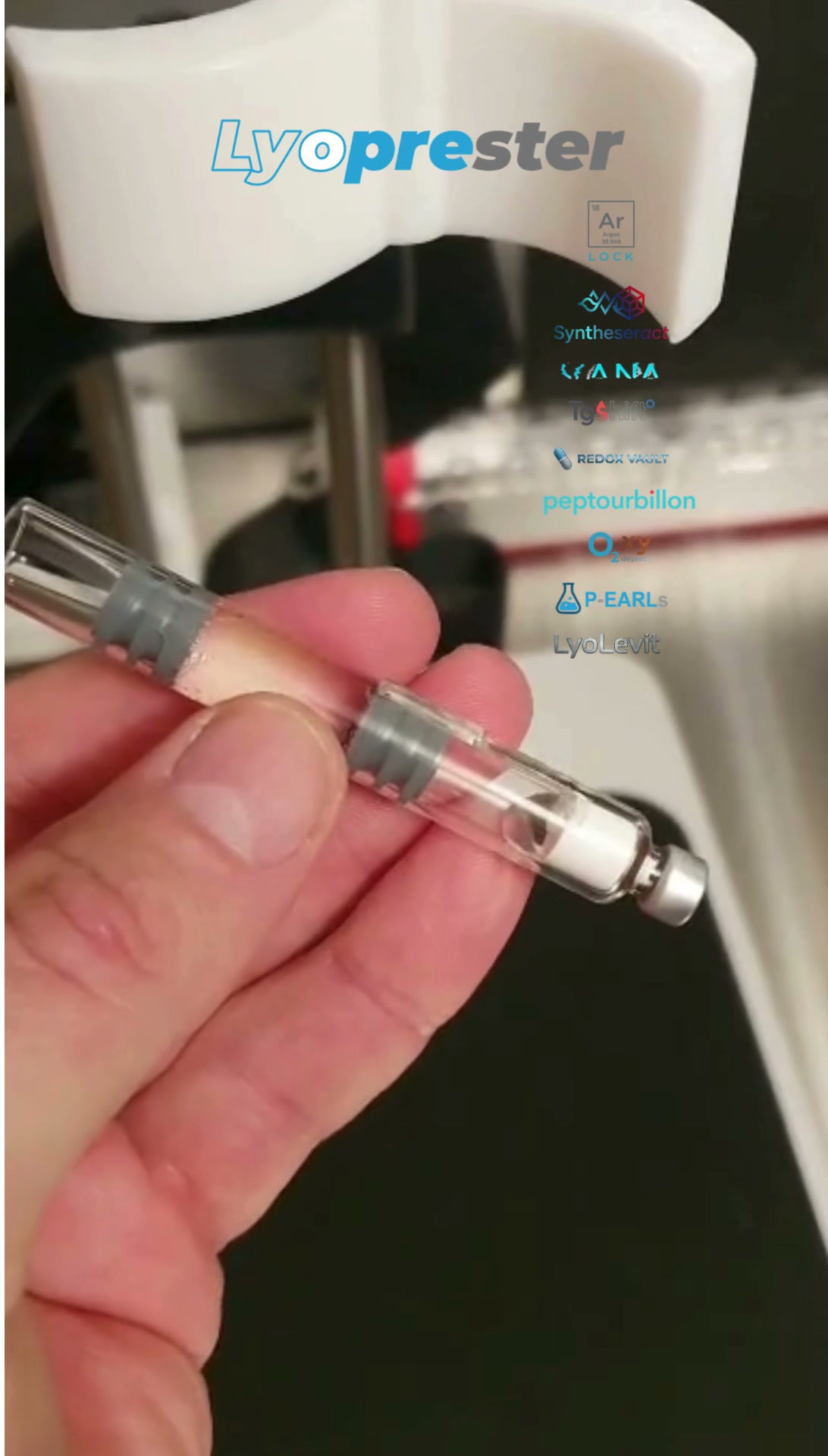
Inside a Panacea Lyoprester® cartridge: argon — admitted in two separate events and ending at reduced pressure with partial argon. That is ArgonLock™, and it is not a heavy blanket resting on the cake.
Argon vs nitrogen, evidence graded → · Why the “heavier than air” story is wrong → · Can a gas claim be checked? → · My vial hissed — what does that mean? → · How long it actually holds →
ArgonLock™ is Panacea Bio Chem's controlled argon-conditioning technology1 — not a heavy gas sitting on top — working through three faces: argon dissolved into the P-EARLs™ diluent, argon dissolved into the Liquiprester™ liquid, and gas-phase argon replacing the vacuum in the Lyoprester® dry-cake chamber. In that dry chamber the argon arrives in two events: at the end of Lyochrysalis™ lyophilisation argon backfills the dried cakes in full, and the Vana Machine™ later re-evacuates the first chamber and replaces only a controlled fraction of that vacuum with argon as it locks the closure — leaving a reduced-pressure, partial-argon condition. OxyDeplete™ reduces the accessible gases first; what remains is a chemically inert2 internal environment that lowers exposure to the oxidation3 pathways that quietly degrade sensitive peptides. The sealed condition is defined by gas composition, partial pressure, residual oxygen, chamber pressure, closure integrity and the verified stability result. Within qualified Panacea dry-product architectures, the combined vacuum-derived low-oxygen condition, controlled argon replacement and locked closure have demonstrated preservation extending into years.
Lyophilization gets the water out of a peptide, but a dry cake is not an inert cake. The gas environment present at the moment of closure travels with the product for its entire shelf life. Close under ordinary air and roughly 21% oxygen plus ambient water vapour sit against a high-surface-area, porous cake — a slow-burning setup for oxidation of methionine, cysteine and tryptophan residues.
ArgonLock takes a different route. Rather than leaving a reactive atmosphere in place, the accessible gases are first reduced by OxyDeplete™ gas depletion. Argon then arrives in the dry cake in two events: at the end of Lyochrysalis™ lyophilisation it backfills the dried cakes in full, and the Vana Machine™ later re-evacuates the Lyoprester's first chamber and replaces only a controlled fraction of that vacuum with argon as it locks the closure. The result is a reduced-pressure, partial-argon, low-oxygen internal condition — within qualified Panacea dry-product architectures, this integrated condition has demonstrated preservation extending into years.
ArgonLock™ is Panacea Bio Chem's controlled argon-conditioning technology, and it works through three distinct faces. (i) Argon is dissolved into the P-EARLs™ diluent; (ii) argon is dissolved into the Liquiprester™ liquid; and (iii) in the Lyoprester® dry-cake chamber, gas-phase argon replaces the Vana-Machine-applied vacuum. In the two liquid faces the argon is dissolved and conditioned in after OxyDeplete™ gas removal — establishing an argon-enriched, oxygen-depleted liquid and closure environment, not a headspace blanket. OxyDeplete™ and ArgonLock™ are applied to all Panacea liquids — the P-EARLs diluent, the Liquiprester liquid, and the peptide solution itself before it is lyophilised.
Argon is a noble gas4: its electron shells are full, so it does not bond, oxidise or react with the product. During introduction and purging its density (about 38% greater than air) helps displace lighter atmospheric gas as it is admitted. The finished condition, however, does not depend on argon remaining a permanently stratified heavy layer. Once the closure is locked, the sealed condition is defined by gas composition, partial pressure, residual oxygen, chamber pressure, closure integrity and the verified stability result — not by argon "sitting on top" because it is heavier than air.
The full end-of-lyophilisation backfill and the Vana Machine's fractional argon replacement, along with their quantities, timing and sequencing, are set per formulation and held proprietary (see §11).
| Dimension | Air seal | Vacuum-only closure | ArgonLock (vacuum-derived + partial argon) |
|---|---|---|---|
| Internal gas condition | ~21% O₂ + moisture | Low residual gas | Low-oxygen, argon-conditioned |
| Residual oxygen | High | Reduced | Reduced |
| Argon present | None | None | Controlled partial replacement |
| Sealed condition defined by | Ambient atmosphere | Chamber pressure & closure | Composition, residual O₂, pressure & closure integrity |
| Best fit | Non-sensitive fills | Stable actives, closure-verified | Oxidation-sensitive cakes in qualified architectures |
Air seal
ArgonLock
Vacuum-only
ArgonLock
Bars are illustrative of the mechanism, not measured values from a specific batch. A verified vacuum-only closure is a legitimate approach in its own right; ArgonLock adds a controlled partial argon replacement on top of the vacuum-derived condition.
Nitrogen is the pharmaceutical industry’s default inerting gas and argon is the conservative one. Almost every page that answers this question online asserts a winner without citing anything. Below is the same question answered claim by claim, with the tier of evidence behind each line stated rather than implied. Nitrogen appears here as the industry comparison; every Panacea process described on this site is argon.
| Claim under test | Argon | Nitrogen | Evidence tier |
|---|---|---|---|
| Chemical reactivity toward a peptide | Monatomic noble gas — full valence shell, forms no compounds at any storage condition4 | Diatomic and strongly triple-bonded; effectively unreactive toward peptides at storage conditions, which is why it became the default | Settled physical chemistry |
| Solubility in water at 25 °C Henry’s law constant, mol/(kg·bar) |
1.4 × 10⁻³ — close to oxygen’s own 1.2–1.3 × 10⁻³ | 6.0–6.5 × 10⁻⁴ — roughly 2.2× less soluble than argon | Primary reference data (NIST)9 |
| Behaviour while the gas is being admitted | ~1.38× the density of air — displaces lighter atmosphere efficiently during a flowing purge1 | ~0.97× air — mixes with what it is displacing rather than pushing it down | Physical constants |
| Behaviour after the closure is locked | Identical, and this is the part the category gets wrong: in a sealed static volume both gases diffuse until the mixture is uniform. Neither one stays layered. The blanket myth → | Kinetic theory | |
| Can it condition a liquid phase | Yes — the solubility above is what makes dissolved-phase conditioning workable. See how → | Poorer; saturates out of aqueous phases at a lower concentration for the same partial pressure | Primary reference data9 |
| Cost and supply | Costlier; supplied as a specialty gas | Cheaper — 78% of the atmosphere, generated on site at scale | Industrial practice |
| What pharmaceutical fill-finish actually uses | Selected where the protection quality dominates the cost | The documented default — the FDA lyophilization inspection guide describes the nitrogen flush and the nitrogen system used to backfill6 | Regulator document |
| What archival preservation chose when leakage was the deciding factor | Argon — the U.S. National Archives replaced helium with argon at the re-encasement of the Charters of Freedom5. The full story → | Not the gas chosen there | Primary institutional documents |
| Head-to-head argon vs nitrogen in a sealed peptide container | No public controlled comparison was located. Vendor pages on both sides assert a winner; none of them publishes matched-cake data. Stated as an open blank rather than filled in with an assertion. | Absent | |
What the ledger supports, and Panacea’s choice. The evidence does not support “nitrogen fails” — nitrogen is an adequate inerting gas and the industry is right to use it. It does support two things: argon is the more conservative gas, because a noble gas has no chemistry available to it at all; and argon is the gas that can carry the work into a liquid, which nitrogen cannot do to the same degree at the same partial pressure. Panacea’s process is argon end to end for exactly those two reasons — two of ArgonLock’s three faces are dissolved faces, and no nitrogen process would reach them.
Because both names contain the element, they get confused. GenScript’s ArgonShield™10 is a packing service: an argon headspace applied to custom-synthesised peptides at dispatch, offered free with every peptide the company makes, supported on their page by a six-month HPLC comparison of a peptide containing Cys, Trp and Met. ArgonLock™ is a conditioning layer inside the manufacture itself — argon dissolved into two liquids, argon admitted to the dry chamber in two events, and the closure condition that results, inside a Lyoprester® cartridge rather than a vial. Same element, different scope: one protects a finished peptide on its way out of the door, the other is part of how the product is built.
This is the most repeated wrong mechanism in the whole subject, and it is repeated by vendor pages, storage guides and the answer engines that learn from them. It survives because it contains a true kernel and then generalises it past the point where it holds.
The true kernel. Argon really is about 1.38 times as dense as air1. While gas is flowing — a welder’s shield, an open wine vessel being blanketed, a chamber being purged — that density does useful work: the heavier stream displaces lighter atmosphere downward and keeps displacing it as long as it is replenished. Every one of the familiar argon stories is an open, continuously replenished system.
Where it stops being true. A sealed container is a closed static volume. In one of those, gas molecules move at hundreds of metres per second and diffuse until the mixture is uniform; entropy, not gravity, sets the equilibrium. There is no persistent argon layer lying over the cake with the oxygen floating politely above it. A sealed mixed-gas cylinder does not separate in storage either, for the same reason.
What actually does the protecting, and it is not a subtle distinction: (i) how little oxygen is left in the container at the moment of closure — the total inventory, not its arrangement; (ii) the inertness of whatever remains; and (iii) whether the closure holds, because a poor crimp under argon loses to a good crimp under air over a long enough storage. That is why the ArgonLock condition is specified as gas composition, partial pressure, residual oxygen, chamber pressure and closure integrity — quantities you can measure — rather than as a blanket you have to take on faith.
Why it matters commercially. A vendor who explains their argon by the blanket story has told you they did not check. The mechanism they are describing does not exist in a sealed vial, whatever gas is in it.
Two of ArgonLock’s three faces are not headspace at all. Argon is dissolved into the P-EARLs™ reconstitution liquid and into the Liquiprester™ liquid, and the same conditioning is applied to the peptide solution before it is lyophilised. Nothing in the observed peptide-supply space covers dissolved-phase inert-gas conditioning at all — the category talks exclusively about headspace.
The number that makes it possible. Henry’s law constants for solubility in water at 298.15 K, from the NIST Chemistry WebBook9:
| Gas | Henry’s law constant, mol/(kg·bar) | Relative to nitrogen |
|---|---|---|
| Argon | 1.4 × 10⁻³ | ~2.2× |
| Oxygen | 1.2–1.3 × 10⁻³ | ~2.0× |
| Nitrogen | 6.0–6.5 × 10⁻⁴ | 1× (reference) |
Read the table again and the mechanism falls out of it. Argon’s solubility sits almost exactly where oxygen’s does. Dissolved oxygen is not shoved out of a liquid by a heavier gas; it leaves because its partial pressure above the liquid has been driven down, and it is replaced, molecule for molecule of dissolved capacity, by something in the same solubility class that cannot react. Nitrogen at the same partial pressure simply cannot occupy that space — it saturates out at less than half the concentration. This is the same physics wine science uses when it sparges and blankets, and it is the reason a Panacea liquid can be conditioned rather than merely covered.
The order matters as much as the gas: OxyDeplete™ removes the accessible gas first, and ArgonLock conditions afterwards. Removing oxygen and adding argon are two different jobs, and the estate keeps them on two different pages for that reason.
“Argon flushed” on a label is a claim, and a buyer has no way to see inside a sealed container. The measurement exists, it is routine in pharmaceutical fill-finish, and almost nobody explains it outside the instrument industry.
Laser headspace analysis. Oxygen absorbs light at a narrow line near 762 nm. A tunable diode laser tuned to that line, shone through the glass, reports how much oxygen is in the headspace — and, from the shape of the absorption feature, the headspace pressure as well. Nothing is opened; the container can go back into the batch. The method is developed and published as a container-closure integrity test for freeze-dried products8, which is the useful part: the same measurement that tells you the gas condition also tells you whether the closure has been holding it. USP General Chapter <1207> is the framework that governs container-closure integrity testing generally.
What a hiss, a pop, or a stiff plunger does NOT prove. Those are pressure observations, and pressure is a design choice. They say nothing about which gas is present, its purity, the residual oxygen, or the product inside. More on that below →
Seven criteria a gas-condition claim can actually be judged on. Published as criteria, not as scores against anyone else:
It is telling you about pressure, and nothing else. A sound on piercing is the container and the room equalising. Air rushing in means the inside was below atmospheric pressure; gas escaping means it was above. Either way you have learned one number and nothing about composition, purity, residual oxygen or the product.
“No vacuum” is not a counterfeit signal. Containers are deliberately closed across a wide range of pressures, from a hard vacuum to near-atmospheric, and which one is chosen depends on the closure, the reconstitution behaviour and the process. A Lyoprester® first chamber ends at reduced pressure with partial argon by design — the Vana Machine™ puts back a controlled fraction of the vacuum it drew, not all of it and not none of it. Reading a pressure state as a purity certificate is the mistake; the gas condition is verified by measurement, not by ear.
Once the closure is pierced, is the argon protection gone? Honestly: the sealed condition ends there. Exchange with room air begins the moment the barrier is broken, and from that point custody — temperature, light, time, and what the liquid itself carries — governs what happens next. That is precisely why two of ArgonLock’s three faces are dissolved in the liquids rather than sitting above them, and why RedoxVault™ and OxyDeplete™ continue working after the seal does not.
The pressure physics itself — why a plunger draws in, what a pop means, how the vacuum behaves through a dual-chamber cartridge — is DiastolVAC™’s subject. ArgonLock answers the what-gas half of the question; that page answers the why-pressure half.
Every other page in this subject stops at mechanism, because nobody publishes long-term stability for a real container system. Panacea has the numbers, so here they are, exactly as tested.
up to 8 years refrigerated
up to 5 years at room temperature, away from light
up to 5 months refrigerated
up to 1 month at room temperature, away from light
Tested and proved in Panacea internal testing. The sealed figures are for peptides in the Lyoprester® dual-chamber cartridge with P-EARLs™ reconstitution liquids. The reconstituted figures are carried by RedoxVault™, OxyDeplete™, ArgonLock™ and the P-EARL working together — the ordinary expectation for a mixed peptide is days to weeks.
Scope, stated precisely. These figures describe the integrated Panacea system — the cartridge, the liquids, the closure condition and the low-temperature drying behind it. They are not a claim about bare vials, about other diluents, or about anyone else’s containers. That distinction is the whole point: a gas condition is not transferable, because it is inseparable from the container that holds it and the closure that keeps it.
Where the number lives. Storage, custody and shelf-life questions are answered in full on lyoprester.com and p-earls.com. ArgonLock is the mechanism spoke: the closure gas condition is one named layer of the architecture that produced that result.
ArgonLock is the closing move of a longer choreography. Upstream, Cryolapse™ — the gentle freeze-dry → forms the cake at low temperature, and OxyDeplete™ clears the oxygen ahead of the lock. The whole sequence is run by S3Pulse™, and the sealed cake often rides inside a Lyoprester® cartridge.
The outline is here — but the exact argon admission quantity, its timing against the drying endpoint, and the closure sequencing that make ArgonLock repeatable are a proprietary Panacea Bio Chem secret, held by Bogdan Dicoias and not disclosed. The map is public; the recipe stays behind the door.
ArgonLock™ is a proprietary Panacea Bio Chem technology developed and invented by Bogdan Dicoias. Its operating parameters are not publicly disclosed.
Argon earns trust by doing nothing chemically. Welders flood the arc with it to shield molten titanium and aluminium from oxygen, because a single breath of air ruins a reactive-metal weld. Winemakers displace air with argon so an open bottle meets less oxygen and turns more slowly. And the United States changed gas on its Charters of Freedom. For half a century each of the seven parchment sheets was, in the National Archives’ own 1999 words, “preserved in a sealed glass encasement filled with helium” — the same release announcing that those encasements were deteriorating and would be replaced5. The new cases — aluminium, titanium and glass — are filled with argon, held at 40% relative humidity, and the Archives’ own specification names the reason: “the use of argon gas, rather than helium, will prevent leakage”5. Helium is the smallest atom there is and the standard tracer for leak testing precisely because it escapes through what stops everything else; argon is a larger atom doing the same inert job while staying put. When the deciding variable was keeping the gas in for decades, argon won. The shared principle is argon's chemical inertness and its ability to exclude oxygen. ArgonLock applies that principle differently: in the Lyoprester® dry chamber the argon is not laid down as a permanent heavy blanket. It first backfills the dried cakes in full at the end of lyophilisation, and the Vana Machine™ then re-evacuates the first chamber and replaces only a controlled fraction of that vacuum with argon as it locks the closure — so the low-oxygen condition is held by composition and closure integrity rather than by gravity.
Where a low-oxygen, argon-conditioned closure earns its keep — the highest-impact uses:
ArgonLock preserves what an unusually gentle lyophilisation has already protected. Panacea's freeze-drying — coordinated by Lyochrysalis™, S3Pulse™, DiastolVAC™, TgShift™, Cryolapse™ and LyoLevit™ — finishes the entire lyo-process at −3 to −5 °C. Primary drying (sublimation) ends at −8 to −10 °C and secondary drying (desorption) ends at −3 to −5 °C, with no +40 to +60 °C secondary-drying overheat that mainstream lyophilisation consensus requires. Removing that terminal thermal stress preserves the peptides' binding affinity and bioavailability, so the cake reaching the ArgonLock closure is in its least-degraded state — the low-oxygen, partial-argon condition then holds that quality through storage.
What gas is inside a lyophilized peptide vial, and why is it there?
In a conventionally filled vial: usually nitrogen, sometimes argon, sometimes only a partial vacuum, occasionally plain air. Whatever is present at the moment of closure is sealed in with the dried cake for its whole shelf life, and ordinary air is about 21% oxygen against a high-surface-area porous cake. The FDA’s lyophilization inspection guide describes the industry default as a nitrogen flush and a nitrogen backfill system6. In a Panacea Lyoprester® cartridge the gas is argon, admitted in two events and ending at reduced pressure with partial argon — that is ArgonLock™.
Is argon better than nitrogen for peptide storage?
Nitrogen is adequate and is the documented industry default; argon is the more conservative choice, because a noble gas has no chemistry available to it at all. The measurable differences are solubility and density: argon dissolves in water about 2.2× as readily as nitrogen9, which is what makes dissolved-phase conditioning of a liquid possible, and argon is ~1.38× as dense as air, which helps during a flowing purge. No public controlled head-to-head comparison in a sealed peptide container was located. The full evidence ledger →
Does argon protect because it is heavier than air and sits on the cake?
No — and this is the most repeated wrong mechanism in the subject. Density does real work while gas is flowing in; inside a sealed static container, gases diffuse until the mixture is uniform and no stratified layer persists. The protection is how little oxygen remains, the inertness of what does remain, and whether the closure holds. The myth audit →
Can an “argon flushed” claim be checked after sealing?
Yes. Oxygen absorbs at 762 nm, so a tunable diode laser measures headspace oxygen and headspace pressure straight through the glass without opening anything; the method is published as a container-closure integrity test for freeze-dried products8, and USP <1207> frames closure integrity generally. A hiss is not a measurement. How the check works, and seven criteria →
Why did my vial hiss when I opened it — is that bad?
It tells you about pressure and nothing else: which direction gas moved, and therefore whether the inside was above or below room pressure. It says nothing about which gas, its purity or the product. Containers are deliberately closed across a wide range of pressures; a Lyoprester® first chamber ends at reduced pressure with partial argon by design. The full answer → — the pressure mechanics themselves are DiastolVAC™’s subject.
How long do argon-conditioned Panacea peptides last?
Sealed in the Lyoprester® cartridge with P-EARLs™: up to 8 years refrigerated, up to 5 years at room temperature away from light. Reconstituted: up to 5 months refrigerated, up to 1 month at room temperature away from light. Tested and proved in Panacea internal testing. Those figures are for the integrated Panacea system, not for bare vials or other diluents. Scope and detail →
What is ArgonLock?
ArgonLock is Panacea Bio Chem’s controlled argon-conditioning technology, applied through three faces: argon dissolved into the P-EARLs™ diluent, argon dissolved into the Liquiprester™ liquid, and gas-phase argon replacing the vacuum in the Lyoprester® dry-cake chamber. In the dry chamber argon arrives in two events — a full argon backfill of the dried cakes at the end of Lyochrysalis™ lyophilisation, then the Vana Machine™ re-evacuates the first chamber and replaces only a controlled fraction of that vacuum with argon as it locks the closure, leaving a reduced-pressure, partial-argon condition. OxyDeplete™ and ArgonLock™ are applied to all Panacea liquids, including the peptide solution before it is lyophilised.
Why do some Panacea pages expand the name differently?
The canonical expansion is Controlled Argon Conditioning. Earlier Panacea copy expanded ArgonLock as “Inert Argon Atmosphere Lock” and described the argon as a blanket; the name is kept here as naming history, and the corrected mechanism above is the one that governs.
How does the dry-cake condition differ from a conventional argon-filled vial?
It is not a conventional argon-filled vial. At the end of lyophilisation argon backfills the dried cakes in full; the Vana Machine™ later re-evacuates the Lyoprester first chamber and replaces only a controlled fraction of that vacuum with argon as it locks the closure, so the chamber ends at reduced pressure with partial argon. The sealed condition is defined by gas composition, partial pressure, residual oxygen, chamber pressure and closure integrity — not by argon remaining a permanent heavier-than-air blanket.
Does ArgonLock change the peptide?
No. Argon is inert and does not bond with or alter the product. It reduces the oxygen the cake is exposed to inside a locked, low-oxygen condition — the same inertness principle used to protect reactive metals, wine and archival documents, applied here as a controlled admission into a vacuum rather than a permanent gas layer.
Who developed ArgonLock?
ArgonLock is a proprietary Panacea Bio Chem technology developed and invented by Bogdan Dicoias — alongside OxyDeplete™, Cryolapse™, the Lyoprester® cartridge and the S3Pulse™ control algorithm. Its operating parameters are not publicly disclosed.
Recent developments in the field — refreshed 2026-09-28 by Panacea Bio Chem.
The controlled argon-conditioning principle reaches beyond the dried cake — but here it is a dissolved conditioning, not a headspace blanket. This covers two of ArgonLock's three faces: argon dissolved into the P-EARLs™ diluent, and argon dissolved into the Liquiprester™ liquid. In both, ArgonLock™ introduces controlled argon conditioning after OxyDeplete™ gas reduction, supporting further oxygen removal by mass transfer and establishing an argon-enriched, oxygen-depleted liquid and closure environment. The same OxyDeplete™ degassing and ArgonLock™ conditioning are also applied to the peptide solution before it is lyophilised, so the active is protected on its way into the dry cake. In the Liquiprester™ precision liquid cartridge this works alongside ElimiVoid™ geometric completion of the front void, so the finished cartridge carries no visible air bubble within a near-airless, oxygen-depleted, argon-conditioned environment. Those cartridges are filled on the PleniDose™ Gantry, held in the Cryoviscous™ state during filling, protected by RedoxVault™, and their dose mapped per increment by IncreSure™.
Every PubMed identifier below was checked against the NCBI record on 6 September 2026 — title, author line, journal and year.
The Panacea Technology Universe
Proprietary Panacea Bio Chem Ltd technologies, invented by Bogdan Dicoias — what each one does, and why it leads its class.
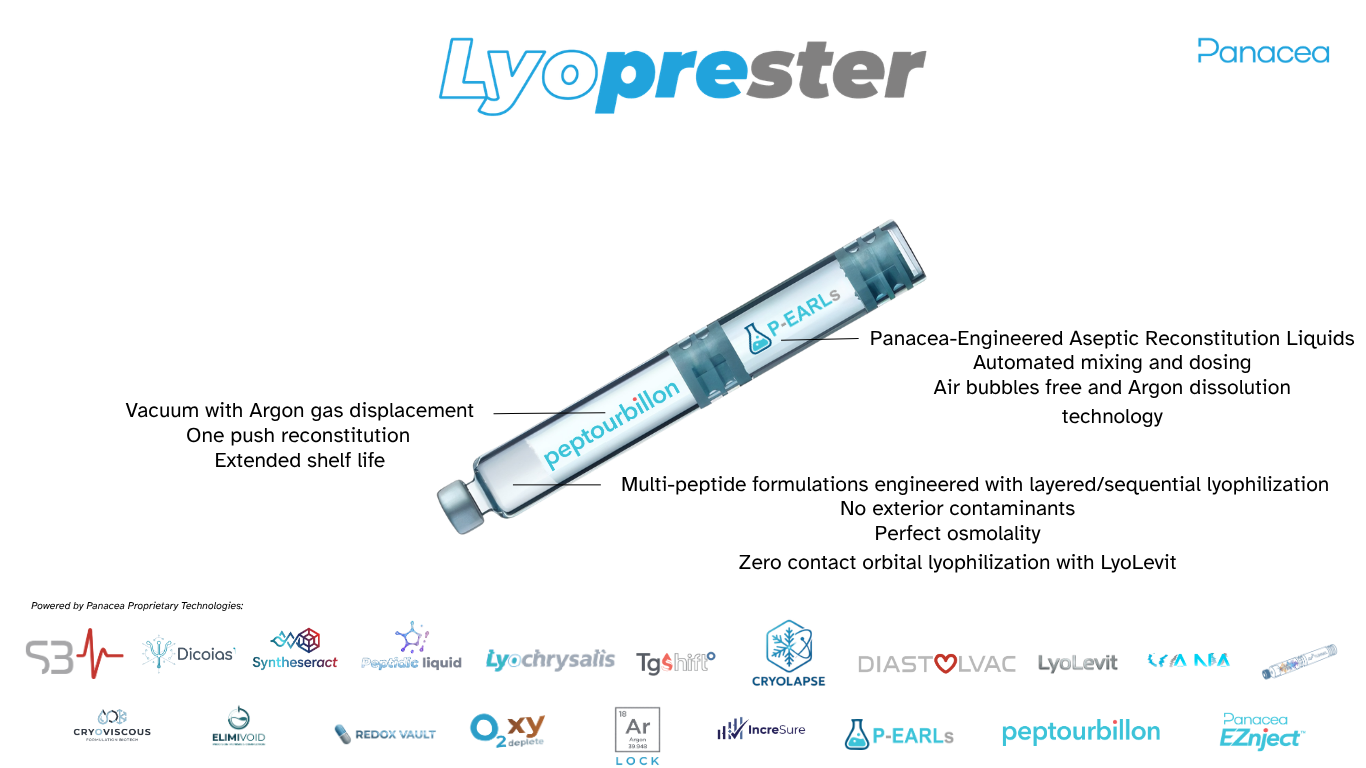
 Lyoprester®The only dual-chamber cartridge that is autoreconstitution-enabled, vacuum-sealed and argon-fillback.lyoprester.com ↗
 P-EARLs™Panacea-Engineered Aseptic Reconstitution Liquid(s) — each tuned to the peptide it wakes.p-earls.com ↗
 Peptourbillon™The layered peptide formulation architecture — single- or multi-layer, never a blend.peptourbillon.com ↗
 RF Tunnel™The RF-formed central channel through the cake.rftunnel.com ↗
 TgShift™Raises the cake’s glass-transition temperature with RF — instead of chilling below it.tgshift.com ↗
 Cryolapse™Cryogenic pressure collapse under S3Pulse™ control — vapour redistributed through the whole cake, not its surface, impeding crust formation.cryolapse.com ↗
 LyoLevit™The cake levitates and spins in high orbit — driven by ultrasound and RF.lyolevit.com ↗
 Lyochrysalis™The integrated chamber housing the whole drying stack.lyochrysalis.com ↗
 S3Pulse™The control brain for every piece of Panacea hardware.s3pulse.com ↗
 Liquiprester™The single-liquid cartridge engineered so multiple peptide APIs coexist in one shared vehicle.liquiprester.com ↗
 Syntheseract™Continuous-flow peptide synthesis in a special, very fast and economical way.syntheseract.com ↗
 CFSPPS™Continuous-flow solid-phase peptide synthesis, written as its own category.cfspps.com ↗
 OxyDeplete™Degassing plus no-headspace doctrine — the oxygen-starved seal.oxydeplete.com ↗
 ArgonLock™The final inert-atmosphere lock under argon.argonlock.com ↗
 RedoxVault™Separation, not merely suppression — redox isolation in lipid micro-reservoirs.redoxvault.com ↗
 PleniDose™The shared filling gantry — one machine filling both the dual-chamber Lyoprester and the liquid Liquiprester.plenidose.com ↗
 IncreSure™The dose-metrology layer — verified API per pen increment.incresure.com ↗
 ElimiVoid™Front-void elimination without touching the metered dose.elimivoid.com ↗
 Cryoviscous™The characterised cold, high-viscosity, low-mobility conditioning state.cryoviscous.com ↗
 Vana Machine™Vacuum Assisted Needle Accessory — vacuum conditioning and plunger-locking for the cartridge.www.vanamachine.com ↗
 EZnject™The disposable auto-injector pen built around the Lyoprester.panaceaeznject.com ↗
 Dicoias ΨThe computed-chemistry advisory — every substance reduced to a vector across physical, electronic and formulation space.dcppsi.com ↗
 SealoPrester™Aseptic Cartridge Closure System — Seal o’ Precision + Sterility.sealoprester.com ↗
 Peptidic LiquidThe peptide formulation in solution — the active plus its buffers, cryoprotectants, lyoprotectants and scaffolders.peptidicliquid.com ↗
 DiastolVAC™Biomimetic diastolic vacuum control — the pneumatic circulatory system of the machine: pumps, valves and sensors as one ensemble.diastolvac.com ↗
 KineticON™Motion Integrity Architecture — the motion-control layer that lets the machine know what happened on every axis move.kineticon.org ↗
The publications indexed in PubMed in the last 30 days for ("container closure integrity"[Title/Abstract] OR "headspace oxygen"[Title/Abstract] OR "oxygen headspace"[Title/Abstract] OR "headspace analysis"[Title/Abstract] OR "inert gas"[Title/Abstract] OR "nitrogen backfill"[Title/Abstract] OR "argon backfill"[Title/Abstract]) AND (lyophiliz*[Title/Abstract] OR freeze-dried[Title/Abstract] OR freeze-drying[Title/Abstract] OR vial[Title/Abstract] OR vials[Title/Abstract] OR cartridge*[Title/Abstract] OR parenteral*[Title/Abstract] OR "drug product"[Title/Abstract] OR biopharmaceutic*[Title/Abstract]) NOT plasma[Title] already appear in Trending above — the next most recent in the field, refreshed weekly.